Details
Director: Hillar Liitoja
Cast: Ken McDougall, Sky Gilbert, Martti Arkko
Venue: Buddies in Bad Times Theatre,
12 Alexander Street Toronto, ON
Production dates:
~January 9, 1992 to January 26th, 1992
Video
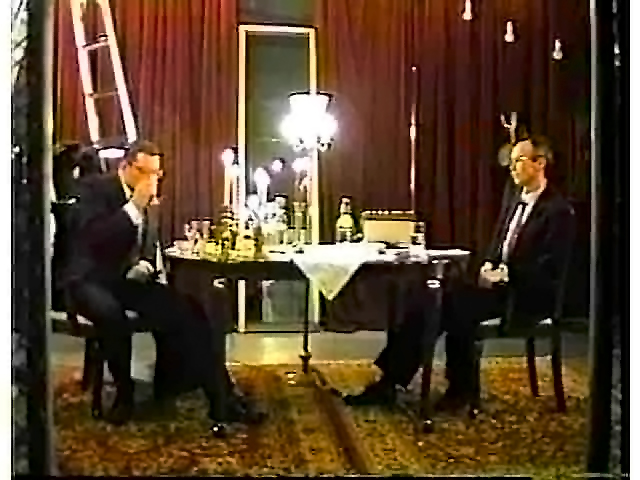
1992
Photos
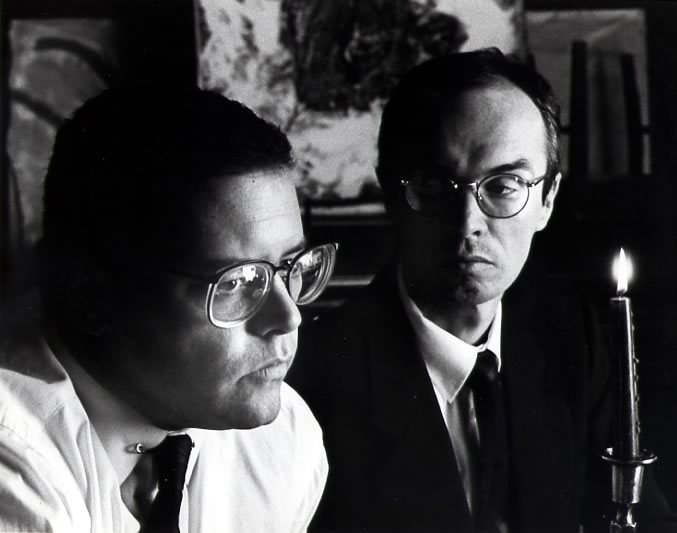
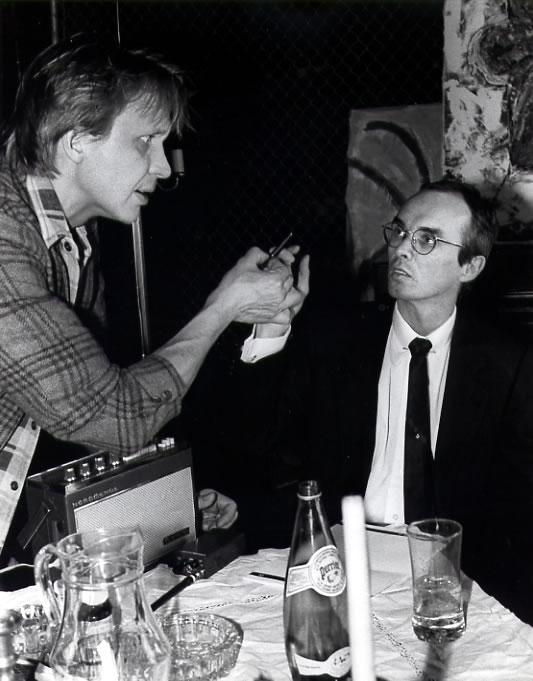
Reviews
A Dark Night of Political Absurdity
As has become customary at Buddies In Bad Times Theatre this season, the business of lining up and getting inside has become part of the theatre-going experience.
In the case of DNA Theatre’s production of Estonian playwright Toomas Hussar’s brutal political absurdist play Ultimate Night, audience participation is a grim prospect.
The entire event is distinctly and intentionally user-unfriendly. No programs are handed out. Ushers in military caps brusquely wave the audience through in groups of two. Some are waved through to their seats; others are asked to empty their pockets for inspection.
Inside the theatre, the set – a slightly messy apartment – is divided from the audience by wire-mesh fencing. A man (Ken McDougall), dressed in an old-fashioned dark suit with a narrow tie, sits, fiddling with the radio dial.
The lights do not go down as the play starts.
Another man (Sky Gilbert), wearing a purple-black animal mask, enters the apartment from a rear door, takes off his coat, mask and hat and sits down. He is dressed identically to the first. For a long time, they do not speak. Then the first man says emphatically, “I took the streetcar.”
There is a brief piece of information dropped about a missing man.
The men begin a very strange conversation that continues thorough most of the play. There are pauses so long they make Harold Pinter’s characters sound like rock radio morning deejays. The men stare at each other. They talk about inanities: turning the radio off and on; lights and candles; the streetcar.
They are peculiarly fastidious about details, like Samuel Beckett’s vaudevillian tramps in Waiting for Godot. But unlike Beckett’s tramps, the absurdity springs out of a more concrete source; they are engaged in something sinister, though it remains hidden until the play’s end.
One man lights candles and begins reciting his “poems,” which are like Hallmark cards written by a schizophrenic. There are obsessive, morbidly sentimental disjointed narratives about lost dogs and sad wolves, and the moon.
About the point where there seems little doubt that the play must be drawing to a baffling close, a third character enters: a simple-minded escaped prisoner named Leo, who has a bad stutter. One of the men pulls out a walkie-talkie and calls for security, but security refuses to come.
What follows is as swift and vicious as the rest of the play has been slow and apparently silly.
What does all this mean? Like other successful minimalist works, the meanings are multilevel and somewhat open-ended. But given the Estonian background, the obvious parallels of world powers making deals to sacrifice the weak are not hard to see. Beyond that, it’s a strangely illuminating examination of the psychopathology of power: the odd incapacity of the two men to feel properly is a product of their political status.
The skill of the acting and direction in this production have an almost subliminal impact: the starkness of the presentation, the bizarre humour and director Hillar Liitoja’s strategically glacial pacing – okay, at times a bit too glacial – conspire to sucker punch the audience.
The retrospective wallop is powerful; it’s the sort of theatre where comprehension begins at the point where the play ends.
The Globe and Mail, January 9, 1992
Ultimately Evil Theatre
If at the end of a production of, say, Aspects of Love, the audience were to sit in a state of dumb silence, afraid to commit themselves through the act of applause, the evening would be considered a total failure. On the other hand, a complete lack of exuberant response in the blackness that follows Ultimate Night is, no doubt, a sign that all has gone according to plan. Any other reaction would be like cheering a particularly gruesome traffic accident, or your worst nightmare.
Created by the twenty-nine year old Estonian playwright, Toomas Hussar, Ultimate Night is a surreal meditation on human evil at its most banal. Profoundly unsettling, this production creates the illusion of a sudden and subtle tilting of the world. It is a total theatrical experience that begins before you have even entered the building.
Running at Buddies In Bad Times Theatre until January 26th, the play depicts the unexplained meeting of two totalitarian leaders in the apartment of a man who has been conveniently “removed” to prison. Borrowing elements from the best writers of twentieth century nightmare literature (Kafka, Orwell, Burgess), Hussar creates two characters infected with power. Men whose minds have been twisted by the knowledge that anything falling within the scope of their gaze is theirs to use or destroy.
The meeting itself is a collision of opposites, overwhelmingly rich in symbolic content and hinging on the idea that there are only two possible ways of living with power: in it or under it. Light competes with darkness, creation with destruction, silence with conversation, comfort with extreme unease.
The two dictators themselves, eerily played by Ken McDougall and Sky Gilbert, oppose each other in character from across a cluttered table. McDougall is the wooden autocrat, a soulless organizer whose only remaining human response is an obsession with the radio. Gilbert is yet more sinister as the amoral aesthete. Swilling alcohol, popping pills, smoking innumerable cigarettes, spouting bad poetry, Gilbert gives the impression that he could snuff out a life as easily as he eats an olive. With the unexpected return of Leo, the apartment’s displaced owner, Gilbert and McDougall, to that point somewhat uncomfortable with each other’s company, are given an opportunity to commune on their common ground.
Martti Arkko depicts Leo, the stuttering innocent who cannot conceive of the power that controls his life. Imprisoned for no apparent reason, he escapes and return directly to his apartment with the simple wish of celebrating his birthday in his own home. Arkko’s heart-breaking performance caps an all-round excellent acting job by the entire cast, including those not on stage.
The set is appropriately dark and all-encompassing, employing authoritarian tricks of manipulation, misdirection and lighting extremes to keep the audience on edge; a feeling that remains long after you have left the theatre. Writing from the perspective of contemporary Eastern Europe, Hussar has created a surreal atmosphere that is all-too believable, and solidified this connection with reality by dedicating the play to 1989’s unofficial meeting on the Mediterranean between George Bush and Mikhail Gorbachev.
Ultimate Night is an extremely satisfying theatrical outing, but be warned, it is no Aspects of Love. It is a nightmare vision, a grotesque shadow-play whose primary purpose is not to entertain. That it does entertain is a bonus. Not to be missed.
Varsity Review, January 13, 1992
DNA Theatre’s Night Ultimately a Disappointment
Whatever Hillar Liitoja and his DNA Theatre create is a must-see. Liitoja is one of the few theatre artists in Toronto constantly redefining the limits of theatrical experience.
Even when that experience is as disappointing as Ultimate Night, it would take a half-dozen similar evenings before his next show would be greeted with indifference.
In Ultimate Night, two dictators – Alexander (Sky Gilbert) and Aleksander (Ken McDougall) – hold a clandestine meeting in a deserted apartment. Their absurdist dialogue is sparse and oblique, occasionally dotted with sardonic humor.
Aleksander is a frigid psychopath, Alexander is sentimental and psychotic.
The apartment belongs to Leo (Martti Arkko), an artist who has been imprisoned without cause. When Leo unexpectedly returns, stuttering and feeble-minded, the dictators murder him and take their leave.
Estonian playwright Toomas Hussar’s allegory would have been dated and clichéd even before the recent liberation of the Baltic states.
Today the play reads like a tedious footnote, a predictable memento mori.
Only superb acting in all the roles relieves the flatness of its mindscape and the apt yet unrelentingly slow pace of Liitoja’s direction.
The lighting and set by Liitoja and William Holutiak feature a metal wire fence surrounding the apartment, which disconcerts the audience as they strain to make out what’s happening inside the animals’ cage. But with such weak material, even inventive ideas like this one end up more stagy than stageworthy.
Ultimate Night is a departure for Liitoja, who has previously drawn on poetry (Ezra Pound), classics (Hamlet) and current events (AIDS) for his unique theatrical creations.
Liitoja’s new relationship with Hussar and contemporary Estonian theatre points to an exploration of roots, and his next work will be a fall co-production in Tallinn.
The voyage home should revitalize his perspectives, and his return to Toronto will be eagerly anticipated.
In the meantime, doubts linger about the direction his work has taken.
DNA Theatre’s strength has always been, as the program note engagingly puts it, “slashing theatrical convention” – and the conventional power relations between the production and the audience in particular.
By overturning expectations about “normal” theatre, Liitoja’s brilliant seven-hour Hamlet unsettled and challenged the audience to see both Hamlet itself – and theatre in general – in a new light.
But the movement from unsettling to disturbing, harassing and attacking is seductive, if not inevitable.
In Sick, his doom-laden meditation on AIDS, Liitoja’s total commitment to his apocalyptic vision redeemed a massive frontal assault on the audience.
In Ultimate Night, however, audience members are intimidated as they enter the theatre, then are perversely lured into two hours of boredom capped by one minute of brutality.
Liitoja should take care that his genius does not degenerate into contempt.
EYE Magazine, January 16, 1992
Guestbooks
After every performance, the audience exits into a space where Guestbooks are laid out. Some write in them; some don’t. Some send emails which are then taped into the books.
- I liked the slowness + stupidity of power, the tedium of repetitive gestures + the cruelness of direction.
- What the hell? Extremely interesting and very damn funny.
- (Meg Nesbit) - This is Christopher with a a bloody nose which was created by ULTIMATE NIGHT. My metabolic rate has been reduced significantly.
- A killer show!
- Nothing is as timeless as the wonderful silences.
- Hillar, it appears to me that this perhaps is the closest you have come to creating a uniform world on language in itself. I also think this goes beyond the small cast. Congratulations.
- (Kirsten Johnson) - Good Ultimate Evening. Y'know, I've attended plays which had so much witty banter packed into so short a time span that my ears imploded bloodily. But tonight, my ears exploded in no time.
- (Adam Foord) - Why did the security person say it was 9:47 and then the guy with the watch said five after five? Just a question.
- Death over easy … so quiet … like a strange redundant dream with a fish. Yes?
- Excellent and profound.
- Powerful, upsetting, sad.
- How delightful to see them [Sky + Ken] in evening wear. The most relaxation I've had in weeks.
- (Clinton) - If I'd known it was over I would have applauded.
- Terribly intense, beautiful language, great vision and performances!!!
- Commitment and focus are the magical elements always present at the DNA circus.
- Very close to real life, which is what we need in Canadian Theatre.
- It is so fresh to sit in silence for so long. Great silence.
- Extremely well done.
- (Anton Wagner) - The communication of frustration was absolutely right on – we all know fascism is stifling – brutal – and ultimately destructive.
- One more thing I will never understand.
- Speechless.