Details
Director: Hillar Liitoja
Cast: Andrew Scorer, Peter Lynch, Ensemble Cast
Venue: Festival de Théâtre des Amériques,
Montréal, QC
Production dates: June 3-6,
1987
Awards: Festival de Théâtre des Amériques Jury Prize for Innovation in Theatrical Writing
Photos
Reviews
Corpses in Orange
Orangeville, Ontario, 1984. Fourteen-year-old Paul strangles two children outside school. Changing his mind, he returns to the building to kill his own sister, who, fortunately, had just left. As in the Du Moutier case (in France), he was found not guilty by reason of insanity.
But this repulsive news item is just the beginning. The play, directed by Hillar Liitoja, doesn't have the macabre charm one might expect. Imagination will do the rest on its own.
The result is more of an extremely complex theatrical orchestration. Far from a script, it's a veritable choreography of chaos.
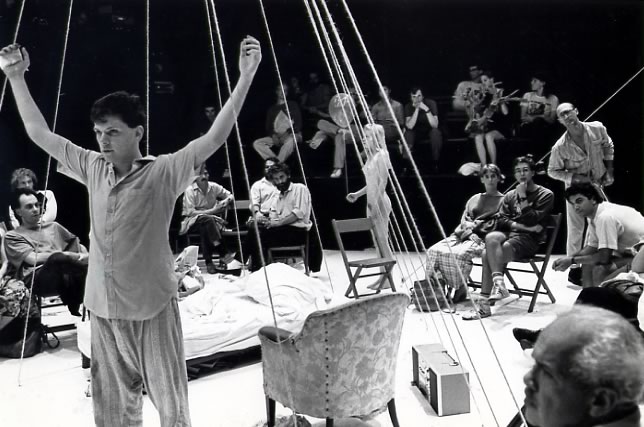
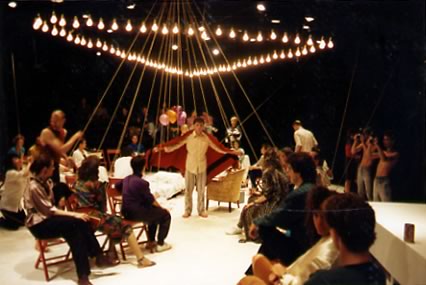
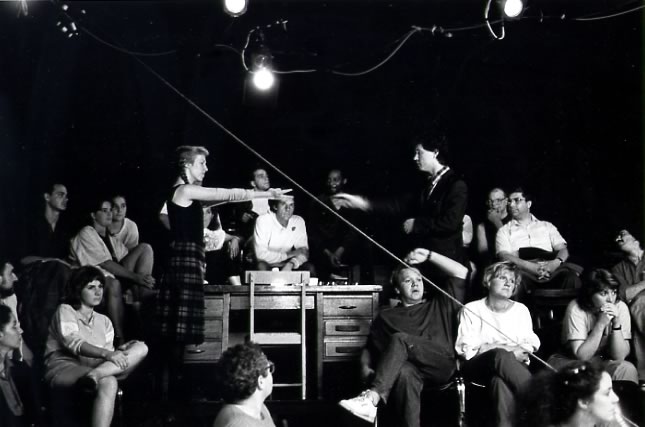
From the outset, you will be invited to sit either in the section normally reserved for the backs of the spectators, or (to pack even more people in) on the stage, straight up!
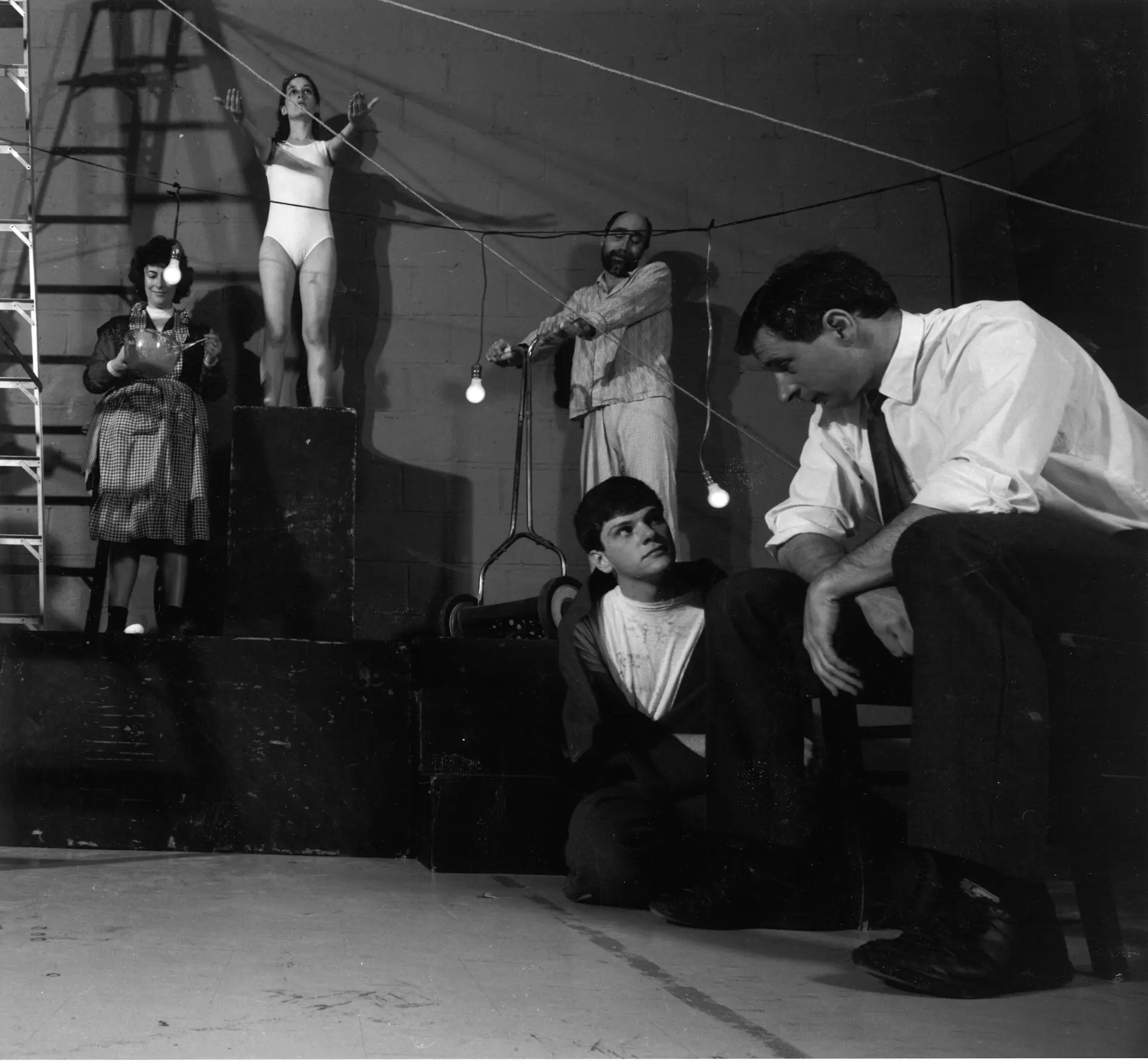
And around you, characters will move about in an apocalyptic atmosphere: the young murderer being questioned by his therapist, his sister holding forth, his father mowing his lawn "live" (the audience in the flowerbeds), his mother cooking and offering you the blessed fruits of her refrigerator's depths, photographers snapping away incessantly, a teacher keeping a student in detention, an excitable fake spectator proving beyond a shadow of a doubt the link between the planet Jupiter and Orangeville. And there will be you and me, completely bewildered.
This infernal cacophony may seem subversive. Don't be fooled, it truly is! Hillar Liitoja completely dismantles the mechanisms of understanding to which we have become accustomed. The message is absent, period.
In fact, everyone will have their own perception of the events. No one will understand the situation in the same way, depending on their relative position. So, if you go out with someone, sit with your peers to avoid arguments.
Hillar, therefore, distorts the terms while having a blast. He's essentially applying Einstein's theory. Your interpretation no longer depends on that of the actor or some lousy director; everything becomes relative to your position in the scene.
No one is in control anymore, everything takes on a meaning yet to be invented, a course you will choose, a destiny. Everything is as messed up as life.
The feeling is sickening because, instead of seeing himself as God (who understands everything), the spectator is necessarily reduced to what he is: a turd, a mentally deranged person, a Man...
Revue Voir, June 4-10, 1987
Cadavres à l'Orange
Orangeville, Ontario, 1984. Paul, 14 ans, étrangle deux enfants au sortir de l'école. Se ravisant, il retourne dans la bâtisse pour liquider sa propre soeur qui, heureusement, venait de vider les lieux. Comme dans l'affaire Du Moutier (en France), le type fut déclaré non coupable pour cause d'aliénation mentale.
Mais ce fait divers repoussant n'est qu'une prémisse. La pièce, du metteur en scène Hillar Liitoja, n'a pas le chachet macabre auquel on s'attendrait. L'imagination fera bien le travail tout seul.
Le résultat est plutôt une orchestration théâtrale extrêmement complexe. Loin du scénario une véritable chorégraphie du chaos.
D'entrée, vous serez donc invité à vous asseoir soit dans la section normalement réservée aux derrières des spectateurs, ou soit (pour paqueter encore plus de monde) sur la scène, carrément!
Et autour de vous évolueront des personnages dans une atmosphère apocalyptique : le jeune meurtrier interrogé par son psy, sa soeur qui disserte, son père qui tond son gazon "live" (le public en plate-bande), sa mère qui popote et vous offre le fruit béni des entrailles de son frigo, des photographes qui flashent à tour de bras, un professeur qui garde un élève en retenue, un faux spectateur exalté qui prouve hors de tout doute le lien entre la planète Jupiter et Orangeville. Et il y aura vous et moi qui n'y comprendrons rien.
Cette cacophonie infernale peut paraître subversive. Ne vous y fiez pas, elle l'est réelement! Hillar Liitoja disloque complètement les mécanismes de compréhension auxquels nous avons été habitués. Le propos est absent, un point c'est tout.
En fait, chacun aura sa propre perception des faits. Personne ne comprendra la pièce de la même façon, dépendant de sa position relative. Alors, si vous sortez accompagné, asseyez-vous avec vos pairs pour éviter les chicanes.
Hillar fausse donc les termes en s'amusant comme un petit fou. Il applique en quelque sorte la théorie d'Einstein. Votre interprétation ne dépend plus de celle du comédien ou d'un metteur en scène minable, tout devient relatif à la position que vous occupez dans l'espace.
Personne ne contrôle plus rien, tout prend un sens qui reste à inventer, un cours que vous choisirez, une destinée. Tout est aussi mal foutu que la vie.
La sensation est écoeurante parce que; au lieu de se prendre pour Dieu (qui comprend tout), le spectateur est nécessairement ravalé au rang de ce qu'il est : une chiure, un aliéné mental, un Homme ...
Revue Voir, du 4 au 10 juin 1987
The Feeling of Being the Only Spectator
Surely the most unsettling, harrowing, and disturbing play of the festival. The premise is simple: in Orangeville, a small town in Ontario, a 14-year-old boy strangles two children. He is subsequently unable to do the same to his sister. Found not guilty at his trial due to mental instability, the teenager is sent to a psychiatric institution.
That's the pretext. Because it's not about experiencing the young murderer's tragedy, witnessing the young man's actions, or reliving the murder. No! It's about us, the spectators.
Let's start from the beginning. Upon entering the lobby of the Théâtre de La Veillée, we see a piano teacher berating a young pianist. We wait quite a while, and then the doorman, grumbling, finally agrees to let us into the theater. Cursing us, he closes the door behind us. While searching for our seats, we hear someone repeating that we can choose a seat, change seats during the performance, but not use the center seat. He repeats this at least fifty times.
In the center of the room, a bed and a sleeping young man. We take our seats. In the four corners of the room, we spot actors. These people are arguing, making a lot of noise, or having fun. A serious, handsome doctor appears. He tries to communicate with the 14-year-old patient. He is turned away. The piano teacher has taken his place in the stands and continues to pester his pupil. Another patient from the hospital appears. He has difficulty speaking. The doctor returns to see the young patient. He is not much more talkative. A burly actor dressed as a cowboy is hurling insults at some people in the room. They are surely actors. The young murderer's sister is dancing. The very one he failed to strangle. Her gaze is empty, vacant. The doctor manages to get some confessions from the young killer, who readily admits to his crime and adds that he enjoyed the experience. It took about ten visits before the patient finally spoke. Time passed, and we watched the elderly, dislocated patient pushing a lawnmower across the floor. An actor tried to speak, describing the planetary alignments above Orangeville, but the music grew louder and we couldn't hear anything.
Spectators leave the theater, but are they spectators or actors? A woman cooks omelets and drops the plate with a crash when she tries to offer a slice. The lights go out and then come back on. It's hard to tell who's performing!
I stayed until the very end of the performance and had the strange feeling of being the only true spectator of this spectacle. Everything becomes suspect, the threat is constant, and one experiences the awareness of alienation. Was this 14-year-old boy guilty? We no longer know. We know nothing.
La Presse, June 6, 1987
Le sentiment d'être le seul spectateur
Sûrement la pièce la plus déroutante, la plus éprouvante et la plus agressante du festival. Le scénario est simple: à Orangeville, petite ville ontarienne, une adolescent de 14 ans étrangle deux enfants. Il ne réussit pas par la suite à faire subir le même sort à sa soeur. Déclaré non couplable à son procés, pour cause d'aliénation mentale, l'adolescent est envoyé dans un institut psychiatrique.
Voilà le prétexte. Parce qu'il ne s'agit pas de vivre le drame du jeune meurtrier, d'assister à la démarche du jeune homme, de reprendre l'assasinat. Non! C'est de nous, spectateurs, qu'il s'agit.
Reprenons depuis le début. En pénétrant dans le hall d'entrée du théâtre de La Veillée on aperçoit un professeur de piano qui engeule une jeune pianiste. On attende un bon moment et puis le portier consent en maugréant à nous faire entrer dans la salle de théâtre. Nous maudissant, il referme sur nos talons. En cherchant notre siège, nous entendons quelqu'un répéter que nous pouvons choisir un place, changer de place pendant le spectacle, mais ne pas utiliser le fauteuil central. Il répète ses propos au moins cinquante fois.
Au centre de la salle, un lit et un jeune homme qui dort. On prend place. Aux quatre coins de la salle, on décèle des comédiens. Ces gens s'engeulent, font beaucoup de tapage ou s'amusent. Un médecin sérieux, belle prestance, fait son apparition. Il tente de communiquer avec le jeune patient de 14 ans. Il est éconduit. Le professeur de piano a pris place dans les gradins et ne cesse de harceler son pupille. Un autre patient de l'hôpital surgit. Il a peine à s'exprimer. Le médecin revient voir le jeune patient. Celui-ci n'est pas tellement plus bavard. Un comédien costaud habillé en cow-boy invective certaines personnes dans la salle. Il s'agit sûrement de comédiens. La soeur du jeune meurtrier danse. Celle-là même qu'il n'a pas réussi à étrangler. Son regard est vide, absent. Le médecin parvient à arracher des confidences au jeune assasin qui admet très facilement son crime et ajoute qu'il a joui de l'expérience. Il aura fallu une dizaine de visites avant que le patient ne s'exprime. Le temps passe et nous voyons le vieux patient désarticulé pousser une tondeuse à gazon sur le plancher. Un comédien veut s'exprimer et raconte le jeu des planètes au-dessus d'Orangeville, mais la musique s'amplifie et on n'entend rien.
Des spectateurs quittent la salle mais sont-ce des spectateurs ou des comédiens? Une femme fait cuire des omelettes et échappe l'assiette avec fracas quand elle veut en offrir une pointe. Le lumières s'éteignent puis sa rallument. On ne sait plus qui joue!
J'ai assisté jusqu'à la toute fin de la représentation et j'ai eu le sentiment étrange d'être le seul véritable spectateur de ce spectacle. Tout devient suspect, la menace est constante et on vit la conscience de l'aliénation. Etait il coupable, ce jeune homme de 14 ans. On ne sait plus. On ne sait plus rien.
La Presse, 6 juin, 1987
This is What Happens in Orangeville
A clash between reason and derangement that provokes almost unbearable chaos. Many spectators leave the theater after being insulted by a violent actor. "You're in the theater, you have a choice." The tension is constant, and the deconstructive structure is disorienting. Centered on the psychoanalysis of a 14-year-old murderer, the entire concept of consciousness versus stupefaction is revealed in the behavior of both the characters and the audience. This show is acidic. Too bad for those who don't appreciate this sure and scathing violence.
The Continuum, Week of September 7, 1987
This is What Happens in Orangeville
Une confrontation de la raison et du dérèglement qui provoque un chaos quasi insupportable. Beaucoup de spectateurs quittent la salle après s'être faits insultés par un comédien violent. "You're in the theatre, you have the choice". La tension est de tous les instants et la structure de la déconstruction déroute. Autour de la psychanalyse d'un jeune assassin de 14 ans, c'est toute l'idée de la conscience par rapport à l'abrutissement qui transparaît dans le comportement des personnages et des spectateurs. Ce spectacle est acide. En tant pis pour ceux qui n'apprécient pas cette violence sûre et décapante.
Le Continuum, Semaine du 7 septembre, 1987
This is What Happens in Orangeville
However, the best part of the English-Canadian selection was to go to an obscure Toronto company, DNA Theatre, which, with This is What Happens in Orangeville, offered an incisive and impactful show thanks to its fragmented treatment of the textual material and the haunting (and structuring) use of two leitmotifs. Based on a true story, the play's premise is simple: a fourteen-year-old boy has killed two children, and a psychiatrist, who visits the young man twelve times, tries to understand what happened; but madness is not where medical knowledge expects it, because this demented behavior is reflected by Hillar Liitoja, the director and playwright, in the microcosm of Orangeville, where programmed and compulsive characters weave a parallel and simultaneous network of collective alienation. By thus materializing the mechanisms of oppression at work in the middle class, the show exploits the cracking of dialogism, and the resulting integral polyphony casts a harsh light on a community that has become incapable of loving its children and is lost in its insignificance or its self-righteous authoritarianism.
Parachute #48, Sept-Nov, 1987
This is What Happens in Orangeville
Toutefois, la meilleure part de la sélection canadienne-anglaise devait revenir à une obscure compagnie torontoise, le DNA Theatre, qui avec This is What Happens in Orangeville a proposé un spectacle incisif et percutant par son traitement fragmenté du matériau textuel et par l'utilisation lancinante (et structurante) de deux leitmotive. Tiré d'un fait réel, l'argument du spectacle est simple: un adolescent de quatorze ans a tué deux enfants et un psychiatre, qui visite le jeune homme à douze reprises, cherche à comprendre ce qui s'est passé ; mais la folie n'est pas là où le savoir médical pense, car ce comportement dément est répercuté par Hillar Liitoja, le metteur en scène et concepteur dramaturgique, sur le microcosme d'Orangeville où des personnages programmés et compulsifs tissent un réseau parallèle et simultané d'aliénation collective. En matérialisant ainsi les mécanismes d'oppression à l'oeuvre dans la classe moyenne, le spectacle exploite la fissuration du dialogisme, et la polyphonie intégrale qui en résulte jette une lumière crue sur une collectivité devenue incapable d'aimer ses enfants et perdue dans son insignifiance ou son autoritarisme bien-pensant.
Parachute #48, Sept-Nov, 1987
This is What Happens in Orangeville : A Bit Like Life
The announcement that Toronto's DNA Theatre would be presenting This is What Happens in Orangeville at the second Festival of Theatre of the Americas garnered little attention from the Toronto media. Only Ray Colongue of the Globe and Mail bothered to mention it, noting that "DNA does interesting fringe work that almost no one sees." He added that the choice of this play illustrated "the dilemma of festivals," elaborating on his point: "It's unclear whether to commend Marie-Hélène Falcon and her collaborators (...) for their diligence in seeing this show, or to criticize them for not choosing a production more representative of Toronto theatre."
While the current situation of DNA Theatre undoubtedly illustrates a dilemma, this dilemma is certainly not that of the Festival de théâtre des Amériques (FTA), as evidenced by the reception of this production in Montreal: the FTA jury awarded Orangeville a prize for experimentation in playwriting, and the public, although their reactions were mixed, respected the seriousness of this exploration of theatrical forms by attending performances in large numbers. In reality, Conlogue's allusion to the "festival dilemma" betrays both a misunderstanding of the FTA's goals and a naive, utopian assumption about "representativeness." No single play can represent the full stylistic diversity of contemporary Toronto theatre, any more than a single production could represent the state of Quebec theatre. The "diligence" shown by the FTA organizers lies in their understanding of this reality and their decision to seek out not national emblems but examples of current innovations in theatrical practice. This choice of Orangeville is a mark of courage, given the obscurity of DNA Theatre, and deserves praise rather than criticism.
The real problems facing DNA Theatre, and the motives behind Conlogue's ambivalent brief, have nothing to do with the decisions of the FTA or any other festival; unfortunately, however, they are only obvious to those familiar with the current state of theatre in English Canada. Increasingly, companies like DNA Theatre are relegated to the margins of theatrical activity where, all too often, they die from neglect. "Almost no one sees" DNA's work because the majority of critics ignore its existence; Conlogue itself hadn't seen Orangeville when it was selected for the FTA, and the play wasn't reviewed in any of Toronto's media outlets, including the city's other two daily newspapers. The reasons for this situation are simple, though their ramifications are complex: newspaper critics are drawn to the productions of mainstream venues such as CentreStage (the St. Lawrence Centre) and Tarragon Theatre, whose established reputations are bolstered not only by substantial government and corporate subsidies, but also by a media "conveyor belt" that elevates their productions to the level of importance of lesser-known companies. This has created a vicious cycle for new and experimental groups, who need media attention both to attract audiences and to secure the financial support that accompanies critical acclaim, if not endorsement. Surviving without the operating grants that would help them adequately promote their shows, these companies seek meager project grants that typically cover little more than venue rental. Simply producing their shows is an achievement for these troupes; The fact that their work is often more stimulating than that of mainstream theatre, which is more financially viable, is a bitter irony that deserves closer examination.
This is certainly the case with DNA Theatre, which, since 1982, has produced thirteen shows in almost as many venues, with minuscule budgets that have made innovation a necessity and obscurity a fait accompli. The first nine of these shows focused on the work of Erza Pound, a personal obsession of Hillar Liitoja, the impetuous artistic director whose innovative approach to theatrical creation places him alongside contemporary "experimenters" such as Tadeusz Kantor, Jan Fabre, and Richard Foreman. In these shows and Liitoja's subsequent presentations, the text is not so much represented as interwoven within an environmental spectacle where all systems of theatrical meaning are questioned through their unusual juxtaposition. The structure of the performance is "orchestrated" rather than written, in that it is constructed like a complex musical piece in which the spoken text(s) are visually represented alongside the other elements of the production (music, movement, lighting, special effects, etc.) on gigantic sheets that resemble enlargements of orchestral scores. This parallel arrangement on paper indicates the simultaneity of all the elements, just as it reveals the repetitive structures that these elements inevitably create. While the score itself is linear, its visual evocation of the multiple levels of representation suggests the mosaic effect of the resulting theatrical event. The spectator is simultaneously offered a diversity of points of interest that compete with one another for attention. While this is inevitably unsettling for an audience accustomed to the linear progression of a production where the text takes precedence, it is nonetheless liberating for those interested in exercising greater perceptual freedom within the course of a theatrical event. Simply put, with so much happening, spectators are allowed (or perhaps forced?) to choose what they watch or listen to at any given moment during the performance. And since spectators are usually dispersed throughout the performance area and often permitted to move around (as opposed to being kept in a fixed, unchanging position on the stage), they can also decide where to look and, in many cases, from what perspective.
While this more recent play differs from the Pound productions in that it was written by Liitoja himself and is centered on a real event—the 1984 murder of two children in Orangeville, Ontario, by a fourteen-year-old boy—its structure is typical of the director's earlier works. However, it also uses the theatrical situation to interrogate the form and nature of "societal" control, and particularly the establishment and maintenance of this control by institutions such as medical "authorities." To this end, Liitoja sets the performance itself in opposition to the rational investigative process at its core—the interrogation of the murderer, Paul, by Dr. Saunders, a psychiatrist convinced he can uncover a motive for the crime. The fundamental nature of this process within the theatrical event, and paradoxically its irrelevance, are both signified proxemically: although the interrogation takes place in the center of the performance area, where a rectangle of bare light bulbs descending from the ceiling frames the armchair and bed that occupy Paul's room in a psychiatric institution, it is surrounded by events that are frequently far more demanding—often, ironically, because of their apparent irrationality. This paradox is further communicated by the instructions each spectator receives individually before entering the performance area: "Sit anywhere except in the armchair"; "feel free to move around." Thus, the degree to which the spectator understands "what is happening in Orangeville" depends not only on where they sit, but also on their willingness to move or change seats. Will he defy theatrical convention to wander around the room, searching for the different experiences of "Orangeville" presented by the characters? Or will he bow to the authority of traditional theatrical practice? If he moves around, his freedom remains nonetheless controlled: he cannot sit in the armchair that denotes the privileged position of the psychiatrist.
Since what one sees and hears during a performance of Orangeville depends on where one sits, it is difficult to evaluate the production according to conventional criteria: here, the adage that everyone sees a different show is to be taken literally. And the performance does indeed seem designed to expose the audience to the relativity of human judgment, insofar as it allows for a diversity of perspectives on the central subject, each perspective influenced by the social context created by the spectators and actors nearby. The fact that Liitoja scatters fake spectators throughout the audience, who reveal their identities in violent or comical interventions, adds to the confusion and blurs the boundaries of critical thinking while challenging preconceived notions about social and artistic reality. This makes the performance unsettling for some, exhilarating for others. It follows that, depending on who you asked, Orangeville was a mind-numbingly good show, brilliant, or somewhere in between – much like life.
Game #46
This is What Happens in Orangeville : un peu comme la vie
L'annonce de la présentation au deuxième Festival de théâtre des Amériques de This is What Happens in Orangeville, un spectacle du DNA Theatre de Toronto, n'a guère retenu l'attention des médias torontois. Seul Ray Colongue, du Globe and Mail, s'est donné la peine de mentionnner la chose, signalant que « DNA fait un travail marginal intéressant que presque personne ne voit ». Il aujoutait que le choix de cette pièce illustrait « le dilemme des festivals », et précisait ainsi sa pensée : « On ne sait si l'on doit féliciter Marie-Hélène Falcon et ses collaborateurs (...) pour la diligence dont ils ont fait preuve en allant voir ce spectacle, ou leur reprocher de ne pas avoir choisi une production plus représentative du théâtre torontois. »
Si la situation actuelle du DNA Theatre illustre sans contredit un dilemme, ce dilemme n'est certainement pas celui du Festival de théâtre des Amériques, comme en témoigne l'accueil réservé à ce spectacle à Montréal : le jury du F.T.A. a décerné à Orangeville un prix pour l'expérimentation en écriture théâtrale, et le public, bien que ses réactions aient été partagées, a respecté le sérieux de cette exploration des formes théâtrales en assistant en grand nombre aux représentations. En réalité, l'allusion de Conlogue au « dilemme des festivals » trahit à la fois une incompréhension des buts du F.T.A. et un présupposé sur la « représentativité » qui est naïf, voie utopique. Aucune pièce ne peut à elle seule représenter toute la diversité stylistique du théâtre torontois d'aujourd'hui, pas plus qu'une production ne pourrait à elle seule représenter l'état du théâtre québécois. La « diligence » dont ont fait preuve les organisateurs du F.T.A réside dans leur compréhension de cette réalité, et dans leur décision de rechercher non des emblèmes nationaux mais des exemples des innovations actuelles dans la pratique théâtrale. Ce choix d'Orangeville est une marque de courage, étant donné l'obscurité du DNA Theatre, et mérite des éloges plutôt que des reproches.
Les vrais problèmes auxquels fait face le DNA Theatre, et les motifs de l'entrefilet ambivalent de Conlogue, n'ont rien à voir avec les décisions du F.T.A. ni d'aucun autre festival; malheureusement, cependant, ils ne sont évidents que pour ceux qui connaissent bien l'état actuel du théâtre au Canada anglais. De plus en plus, des compagnies telles que le DNA Theatre sont reléguées aux marges de l'activité théâtrale où, trop souvent, elles meurent par négligence. « Presque personne ne voit » le travail du DNA parce que la majorité des critiques passent son existence sous silence; Conlogue lui-même n'avait pas vu Orangeville lorsque ce spectacle a été sélectionné pour le F.T.A., et la pièce n'a été critiquée dans aucun des médias torontois, les deux autres quotidiens de la ville y compris. Les raisons de cette situation sont simples, bien que leurs ramifications soient complexes: les critiques des quotidiens sont attirés par les productions des lieux à vocation « grand public » tels que le CentreStage (le St. Lawrence Centre) et le Tarragon Theatre, dont la réputation bien assise est soutenue non seulement par des subventions considérables des gouvernements et des entreprises, mais aussi par une « courroie de transmission : médiatique qui valorise leurs productions comme étant plus importantes que le travail des compagnies moins connues. Cela a engendré un cercle vicieux pour les nouveaux groupes et les groupes expérimentaux, qui ont besoin de l'attention des médias à la fois pour attirer des spectateurs et pour obtenir l'aide financière qui accompagne l'attention des critiques, sinon leur approbation. Subsistant sans les subventions de fonctionnement qui pourraient les aider à faire une promotion adéquate de leurs spectacles, ces compagnies quêtent de maigres subventions de projet qui, d'ordinaire, ne couvrent guère plus que la location du lieu de représentation. La simple production de leurs spectacles est un exploit pour ces troupes; le fait que leur travail soit souvent plus stimulant que celui du théâtre grand public, plus solvable, est une âpre ironie qui mérite qu'on s'y attarde.
C'est certainement là le cas du DNA Theatre qui, depuis 1982, a produit treize spectacles dans presque autant de lieux, avec des budgets infimes qui ont fait de l'innovation une nécessité, et de l'obscurité un fait accompli. Les neuf premiers de ces spectacles étaient axés sur l'oeuvre d'Erza Pound, une obsession personnelle de Hillar Liitoja, l'impétueux directeur artistique dont l'approche innovatrice de la création théâtrale lui fait joindre les rangs d' « expérimentateurs » contemporains tels que Tadeusz Kantor, Jan Fabre et Richard Foreman. Dans ces spectacles et les presentations postérieures de Liitoja, le texte n'est pas tant représenté qu'entrelacé dans un spectacle environnemental où tous les systèmes de signification théâtrale sont mis en question par leur juxtaposition inusitée. La structure de la représentation est « orchestrée » plutôt qu'écrite, en ce sense qu'elle est construite comme une pièce musicale complexe dans laquelle le ou les textes parlés sont visuellement représentés à côté des autres éléments de la production (musique, mouvement, éclairage, effets spéciaux, etc.) sur de gigantesques feuilles qui ressemblent à des agrandissements de partitions d'orchestre. Cette mise en parallèle sur le papier indique la simultanéité de tous les éléments, tout comme elle révèle les structures répétitives que ces éléments créent inévitablement. Si la partition est en soi linéaire, l'évocation visuelle qu'elle fait des niveaux multiples de représentation suggère l'effet de mosaïque de l'événement théâtral qui en est issu. Le spectateur se voit offrir simultanément une diversité de points d'attraction qui se concurrencent l'un l'autre pour gagner l'attention. Bien que cela soit fatalement déstabilisant pour un public habitué au déroulement linéaire d'une production où le texte a préséance, ce n'en est pas moins libérateur pour ceux qui s'intéressent à l'exercice d'une plus grande liberté perceptuelle dans le cours d'un événement théâtral. Tout simplement, avec tant de choses qui se passent, on autorise (on force?) les spectateurs à choisir ce qu'ils regardent ou écoutent à tout moment de la représentation. Et dans la mesure où les spectateurs sont d'ordinaire dispersés dans l'aire de jeu et souvent autorisés à se déplacer (par opposition à leur maintien dans un rapport fixe, inaltérable à la scène), ils peuvent également décider de l'endroit où regarder et, dans bien des cas, de la perspective dans laquelle le faire.
Si cette pièce plus récente diffère des spectacles sur Pound en ce qu'elle a été écrite par Liitoja lui-même et est centrée sur un événement réel – l'assassinat de deux enfants à Orangeville, en Ontario, par un adolescent de quatorze ans en 1984 – , sa structure est typique des présentations antérieures du metteur en scène; mais, par surcroît, elle se sert de la situation théâtrale pour interroger la forme et la nature du contrôle « sociétal », et particulièrement de l'établissement et du maintien de ce contrôle par des institutions telles que les « autorités » médicales. Pour ce faire, Liitoja fait travailler en antagonisme le spectacle et le processus d'enquête rationelle qui en est le coeur même – l'interrogatoire de l'assassin, Paul, par le Dr Saunders, un psychiatre convaincu de pouvoir mettre le doigt sur un motif à ce crime. La nature fondamentale de ce processus dans l'événement théâtral et, paradoxalement, sa non-pertinence sont toutes deux signifiées proxémiquement: bien que l'interrogatoire se déroule au centre de l'aire de jeu, où un rectangle d'ampoules électriques nues descendant du plafond encadre le fauteuil et le lit qui occupent la chambre de Paul dans un établissement psychiatrique, il est entouré d'événements qui sont fréquemment beaucoup plus sollicitants – souvent, ironiquement, en raison de leur irrationnalité apparente. Ce paradoxe est communiqué en outre par les directives que reçoit individuellement chaque spectateur avant d'entrer dans l'aire de jeu: « Asseyez-vous n'importe où, sauf dans le fauteuil »; « sentez-vous libre de vous déplacer. » Ainsi, le degré de compréhension par le spectateur de « ce qui se passe à Orangeville » dépend non seulement de l'endroit où il s'assoit, mais aussi de son désir de se déplacer ou de changer de siège. Défiera-t-il la convention théâtrale pour se promener dans la salle, à la recherche des expériences différentes d' « Orangeville » que présentent les personnages? Ou s'inclinera-t-il devant l'autorité de la pratique théâtrale traditionnelle? S'il se déplace, sa liberté n'en demeure pas mois contrôlée: il ne peut pas s'asseoir dans le fauteuil qui dénote la position privilégiée du psychiatre.
Puisque ce que l'on voit et entend dans le cours d'un représentation d'Orangeville dépend de l'endroit où l'on s'assoit, il est difficile d'évaluer la production en fonction de critères conventionnels: ici, l'adage selon lequel chacun voit un spectacle différent est à prendre au pied de la lettre. Et le spectacle semble en effet conçu pour exposer au public la relativité du jugement humain, dans la mesure où il permet une diversité de points de vue sur le sujet central, chaque point de vue étant influencé par le contexte social créé par les spectateurs et acteurs avoisinants. Le fait que Liitoja dissémine dans le public de faux spectateurs qui dévoileront leur indentité dans des interventions violentes ou comiques vient ajouter à la confusion, et estompe les frontières de la capacité critique tout en mettant en question les idées reçus sur la réalité sociale et artistique. Cela rent le spectacle déstabilisant pour certains, exaltant pour d'autres. Il s'ensuit que, selon la personne à laquelle on s'adresse, Orangeville était un spectacle assommant, brillant, ou se situait quelque part entre les deux – un peu comme la vie.
Game #46
Bold Style Masks Some Flimsy Ideas
Anyone familiar with the slow-motion, dream-like world of the American theatrical innovator Robert Wilson will notice an immediate – if superficial – similarity with the DNA troupe's This is What Happens in Orangeville, brought to town from Toronto this week by the Theatre Festival of the Americas.
Whether writer/director Hillar Liitoja comes anywhere near Wilson's rigor and breadth of imagination is a highly debatable question. Ostensibly, the piece is a confrontation between a 14-year-old boy who has strangled two children and the psychiatrist charged with investigating his mental health. Friends and relatives loom on the fringe, spouting fragments of reaction.
Stage time seems measured in eons. A slow-witted man stands catatonic, holding driftwood, muttering about his neighbors; a dimple-cheeked mother chats on about their family life, meanwhile preparing an omelette which she hands to a spectator; a naked girl holding balloons appears from a trap door and inches her way across the room; a loony fellow rambles on about the position of Jupiter at the time of the killing. Half a dozen times, the boy dismisses his psychiatrist without a real exchange.
Clearly, character and motivation aren't the point here. This living museum of human types seems to be about the repression, self-delusions and dangerous bestiality to be found underneath the ordinary chatter of small-town life. Next to the long line of earnest-issue plays which persist on English-Canada stages, this is definitely a new approach to headline-inspired theatre.
But Liitoja's bold style doesn't quite mask the fact that underneath are some pretty flimsy and pretentious ideas. Any 10-minute excerpt would adequately sum up the whole. Evil may be banal, as Hannah Arendt said after attending Adolph Eichmann's trial 25 years ago. But that's no excuse for the same fault in a work of art about evil.
Where DNA's assault on conventional theatre really works (and probably works against its own theme) is breaking down barriers between spectators. The house lights (including 100 100-watt bulbs) are on throughout. About 100 spectators are seated at various angles in and around the action, so you can wave at friends, exchange shrugs, observe giggles, nod at grimaces, go for a drink, change seats or walk out without in any disturbing the performance. Frankly, watching people watch Orangeville is a lot more interesting than Orangeville itself.
The Gazette, June 5, 1987
Guestbooks
After every performance, the audience exits into a space where Guestbooks are laid out. Some write in them; some don't. Some send emails which are then taped into the books.
- It was a most interesting + controversial performance made clearly to be "anti-performance".
- (Marie-Christine Colban) - Started out hating it, but it grows on you. Won me over by the end. Specially appreciated the beer.
- Most unlimiting play I think I've ever seen.
- Very Bad – Very Amateur. Very very not welcome!! Thank you
- Puta que buena cosa que fue eso!
- (Patricia Diaz - de Chile) - You opened up my eyes and senses to an experience I will never forget!
- (Rifki Guetta) - Tourbillon & ivresse du monde actuel. "De la musique avant toute chose" (Verlaine) Surrealiste? Fou! "Lá tout n'est qu'ordre et calme / Luxe, et volupté" (Baudelaire)
- I never saw so many things happening between the spectators during the show, and I see a lot of them. I never hesitated so much to leave a theatre after a show. I knew it was over, but somehow, I felt I should stick there. My girlfriend loved the omelet!
- étrange et sublime
- Miserable.
- J'ai aimé énormément le show et j'ai jamais vu un spectacle aussi emouvant. Ça me fait vivre des émotions profondes.
- Le show du festival!
- L'audace & l'insolite – une belle paire! I enjoyed the "form".
- (Elyse S.) - Too bad! You lost, you missed your chance! But don't try another time please! Just take it easy now. Please, make silence. … But please, don't try to become extraordinary, or exceptional, or to find a new style. … I was ready to receive you, but you were not ready to talk to me. … I'm sure that you don't feel your audience like you have to.
- A case of the emperor's new clothes!! Were you making fun of us?
- Beaucoup pour les yeux, beaucoup de feelings. Tous en même temps mais amalgamés avec geniè! Bravo
- (José)