Details
Director/Choreographer: Hillar Liitoja
Cast: Ken McDougall, Jim Allodi, Sky Gilbert
Venue: Theatre Passe Muraille Backspace,
Toronto, ON
Production dates: 1993
Awards: 1994 Dora Mavor Moore Awards, Independent Theatre Award for Outstanding Direction, and Independent Theatre Award for Outstanding Production (1994 Production)
Photos
Reviews
The Last Supper
Mercy kills. Or does it? In his latest work, The Last Supper, playwright and director Hillar Liitoja has taken the controversial subject of euthanasia and created an elegant testament to choosing to die with dignity.
By setting the play in a time when euthanasia is an accepted practice, Liitoja escapes dealing with ethical questions and instead invites the audience to participate in a “performance of euthanasia.”
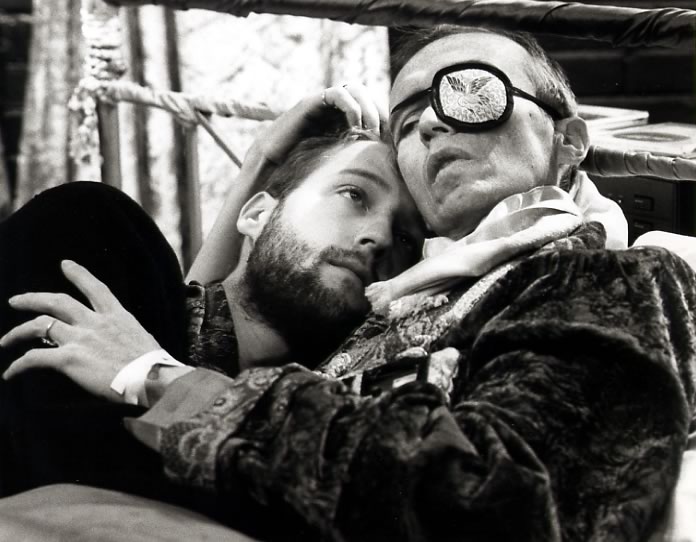
Incapacitated by his illness, Chris (Ken McDougall) has decided to die. His lover Val (Jim Allodi) and Dr. Parthens (Sky Gilbert) are at his side to tend to his final requests and assist in his dying. The dynamics created between these three actors as they pull the audience into their tight circle are a rare treat. The unnatural dialogue is jarring at times, but astute: how can conversation come naturally when all the participants would rather be somewhere else?
As the consummate caregiver, Jim Allodi’s performance is exceptional as he busies himself with domestic chores and feigns enthusiasm while preparing for his last supper with his beloved. McDougall’s Chris is barely audible, making all present – including the audience – strain to hear him, hoping to grasp everything he utters without disturbing the moment. Sky Gilbert’s Dr. Parthens is suitably awkward and completely endearing.
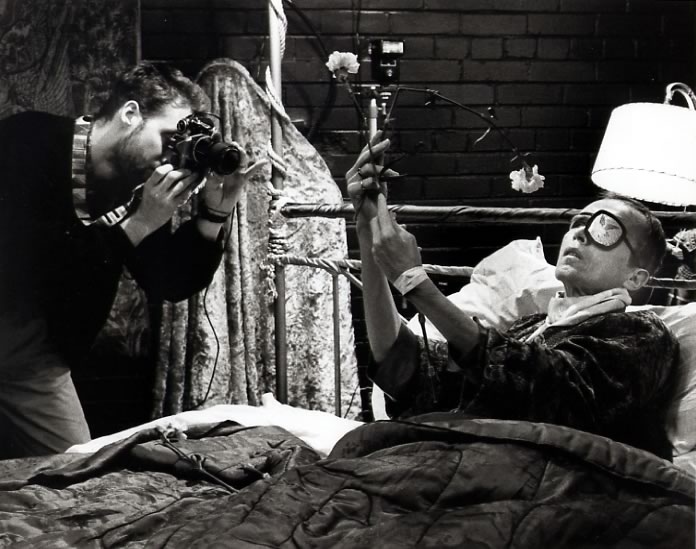
The Backspace has been transformed into a bedroom, with the audience seated around a huge bed on various chairs and cushions. It’s uncomfortable at times, but that’s exactly what’s intended. From the soft lighting to the plastic under the fitted sheet, much attention to detail has helped to create the claustrophobic atmosphere of impending death. At two-and-a-half hours, the performance is short compared with Liitoja’s four-hour poetry epic Poundemonium last spring
Unpretentious and compelling, The Last Supper transcends melodrama, and stays with you well after you’ve left the theatre. As such, it’s fitting that in English, Theatre Passe Muraille translates to “theatre beyond walls.”
EYE weekly, October 21, 1993
Last Supper Memorable
In writer-director Hillar Liitoja’s remarkable new drama The Last Supper, a celebrated dancer carefully choreographs his final performance: his passage from this stage to the next.
Chris (Ken McDougall) is dying of a degenerative illness that is probably related to AIDS. In obvious pain and determined to exit gracefully and with style, he enlists the help of his lover, an equally accomplished photographer, Val (Jim Allodi), and a sympathetic physician, Parthens (Sky Gilbert).
The play is described in the promotional material as “a performance of euthanasia”, but don’t expect a debate around the morality of assisted suicide. Chris’s right to choose death is never questioned. Instead, the drama focuses on the self-directed artistry of his final moments.
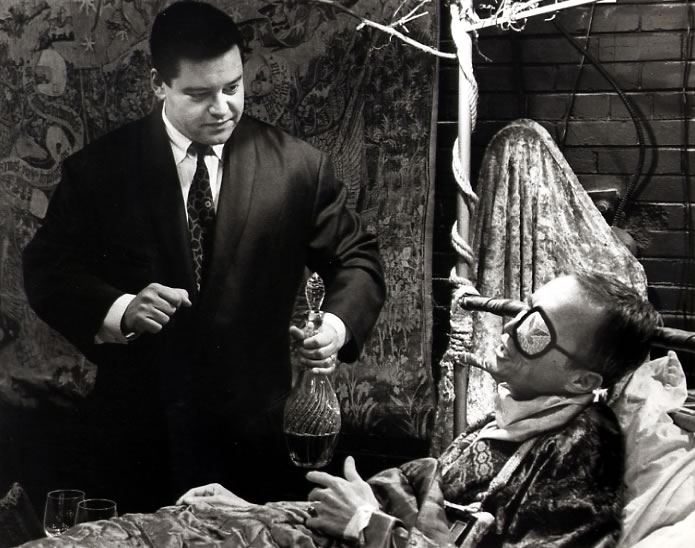
No detail, no matter how minute, eludes Chris’s preparations. He orders salmon and ratatouille for his last meal, washed down by a vintage French wine purchased at a London auction. His final acts include being photographed doing a masked performance in bed and rehearsing the anticipated moment of his death, an event so meticulously plotted that he even has instructed Parthens to inject the lethal dose at a precise moment in a favourite symphony, cued up on the CD player.
For Liitoja, the uncompromisingly avant-gardist founder of DNA Theatre, The Last Supper ranks as straight-forward, if not altogether accessible, fare. Rigorously naturalistic, the three-hour show is staged in real time, the action advancing at hardly more than the pace of an Andy Warhol documentary about the Empire State Building. This inevitably invites frequent lulls but, as is often the case with minimalism, the approach gathers momentum with time.
By transforming the Theatre Passe Muraille Backspace into Chris’s bedroom, set designer Steve Lucas has created an extraordinarily intimate environment, filled with interesting artefacts from the characters’ lives and redolent of carnations and ripening fruit. The audience, sharing space with the performers, is invited to move around, although seating is available to those who need to maintain the illusion of the fourth wall, even when they’re inside of it.
The actors fit their performances to scale, with small gestures and whispers that are intelligible to everyone in the house. They even make any necessary technical alterations as they go, lighting candles and playing music, as the mood necessitates.
McDougall’s Chris, a combination of waning, wheezing frailty and unwavering determination, is never less than convincing. Allodi, perplexed but deferential, and Gilbert, confident and accommodating, are strong in support.
The Last Supper is not everyone’s meat. But for those seduced by its unhurried, slice-of-life rhythms, is likely to stand as a memorable investigation into the relationship between life, ritual and art.
Toronto Star, October 22, 1993
Last Supper: A performance of euthanasia
By now, everyone knows to expect the unexpected from Liitoja’s DNA creations. He is regarded as one of Canada’s most influential and challenging theatre artists. In my experience with his style of theatre, I found myself agreeing and always thirsting for more. Patience and a willingness to be distressed by your own inner monsters are necessary to be able to withstand Liitoja’s universe.
The announcement that his current production dealt with a terminally ill man, who, in a time when euthanasia is legal, wishes to choreograph the last three hours before his death, no longer shocked. In fact, it was rather intriguing.
The Backspace had been transformed into Chris’s (Ken McDougall) bedroom, and the action was to take place in real time: three hours – which is nothing if you remember his Hamlet or the more recent Poundemonium. Screened at the door and proceeding through a standard DNA entrance ritual, the audience inhabited the cozy cluttered room at the booming sounds of Mozart’s Jupiter Symphony. The centre of the room was dominated by Chris’s bed, McDougall already lying in it. As his love Val (Jim Allodi) appeared, the “play” began. But soon after, the eccentricity wore off and one was left with two-and-a-half hours of forced dialogue, awkward plot developments and boredom.
Liitoja has dehumanized his characters to such an extent in his pursuit for absurdity that they have become puppet caricatures reciting trite lines. During their last supper together, Val and Chris reminisce about happier times travelling through Europe. Excruciating pain can be seen on Allodi’s face, as McDougall remains resolute in his decision, but the dialogue is atrocious. Liitoja has packed it with obscure references in cryptic format, inducing an extreme sense of pretentiousness and thus completely eradicating any possibility of sympathy or attachment we might develop for Val and Chris.
Sky Gilbert’s blank portrayal of Dr. Parthens is cold and insincere, and his presence is always a clumsy intrusion. The ultimate in embarrassing theatrical choices is Chris’ decision to dance – masked – for the last time while his lover takes pictures. A potentially beautiful goodbye is overdone by flinging white flowers and ridiculous hand movements.
In order to fill the three hours, Liitoja played an entire symphony, screened the ending of Kubrick’s Space Odyssey, and had Val show Chris one by one several objects of art from the bedroom. Quantity rather than quality seemed to be Liitoja’s guide, a tendency illustrated even in the set design.
One always expects to be disturbed by a DNA performance but never until now, disappointed.
Theatrum #37, February/March 1994
A Tiny, Perfect Suicide
Writer-director Hillar Liitoja’s previous performance piece, Poundemonium, was presented in a vast, lofty former church (now a designer furniture shop, by the way), and he filled every nook and cranny of it with eccentric action.
He has reversed his field entirely with The Last Supper, subtitled a performance of euthanasia. The already cramped Passe Muraille Backspace has been even further reduced, to bedroom size, and the audience is invited in to witness, in intimate detail, a tiny, perfect and socially sanctioned ceremonial suicide.
Chris (Ken McDougall) is the painfully, terminally ill dancer who partakes of this last supper – salmon and ratatouille – on the last evening of his life. The food and the evening are both lovingly prepared and served by his lover, a photographer named Val (Jim Allodi). No illness is ever specified, but it is clearly wasting and intermittently excruciating. Chris is gaunt, bed-ridden and horribly weak, and McDougall speaks in a hoarse whisper throughout, barely moving but emanating amazing emotion and personality; it’s an extraordinary, courageous performance.
Val attends to all of Chris’s last wishes on this night: the right music (mostly lush, romantic strings and horns); a final viewing of 2001; the perfect wine; reminiscing over photos of their travels; last looks at favourite works of art, including some of Val’s photographs. Allodi is low-key, almost reserved, for the most part, although his bereavement, when the time arrives, is devastating to watch.
This is an understandably low-key drama, but Sky Gilbert finds an even lower gear as Dr. Parthens, who assists during the evening and oversees the final moments, administering the fatal injection (“Parthian shots”). Gilbert – bulky, broad-shouldered, shaved bald and dressed in black – looms whenever he is in the room, but plays Parthens in a slow-motion monotone.
This is perhaps intended to suggest the dead hand of the bureaucratic apparatus that would inevitably spring up if assisted suicide were legal (a point nailed when the ambulance attendants arrive to take away the body), but Parthens feels like a wasted character or an unfinished theme, and is a dramatic dead spot in the production.
The press material says “We presume a time when death is legal,” thus removing the play from the controversy of “the right to die”, even while plainly taking a position in favour of it. But The Last Supper is not about the right to die, it is a romantic fantasy about a perfect voluntary death, an up-close look at a moment when death and love intersect. (It is also genderless; the neutrally named Chris and Val could be any loving couple.)
There is some gentle humour, mostly courtesy of McDougall, and several enormously moving scenes. But this is challenging theatre in many ways: apart from the almost embarrassing intensity and intimacy of the performances and the subject, there are long stretches of time when nothing happens; what does happen is often banal.
Further challenge: except for the condensed 2001 and some apparent compression in Chris’s nap-times, the three-hour show is done in real time. The couple of dozen possible viewers are given a choice of permanent seating or the right to roam around the bedroom set (designed by Liitoja and Steve Lucas, and dressed in loving detail by Wendy White). I recommend roaming; you can see better, and the seating is uncomfortable in either case.
The Globe and Mail, October 29, 1993
Intimate Dining
In his exploration of the last three hours in the life of a terminally ill man, Hillar Liitoja tones down his sometimes imaginative excess to tell a story in small-scale, human terms.
Set in a time when euthanasia is legal, the play follows in minute detail the last meal and farewells of the terminally ill but optimistic dancer Chris (Ken McDougall) and his photographer lover Val (Jim Allodi) and Chris’ humane death at the hands of his doctor (Sky Gilbert).
The performances are committed – especially McDougall’s, delivered with laboured breathing and in a raspy, whispered voice. The space design by Steve Lucas and Liitoja – with an emphasis on ripe fruit and rich tapestries – is also detailed, as is Liitoja’s loud soundscape of classical music.
Given the situation, daily ephemera – played out in real time – are given enormous final meanings. The production draws the audience along emotionally much of the time, but it’s not a theatrical journey that everyone will want to take.
NOW Magazine, October 28-November 3, 1993
Guestbooks
After every performance, the audience exits into a space where Guestbooks are laid out. Some write in them; some don’t. Some send emails which are then taped into the books.
- Well, another splendid, wonderful piece of theatre from HL/DNA – notwithstanding setting a new standard of theatre / reality.
- (Ed Fielding) - Hillar, it is a jewel of a piece. Love + admiration always.
- (Kirsten Johnson) - It's me again, Kirsten. What can I write as an addendum? Same yet more cuts, angles, reflections, refractions. I'm speaking of karats I guess
- I want to tell you that this incredible. I have never seen anything like this. Thank you so much Hillar, Ken, Sky and Jim.
- (Fabrizio Fillipo) - Shattering.
- Very peaceful.
- (Gordon Foster) - Extremely tender and moving portrayal, especially the dance.
- So sensitively written and acted.
- (Sandor Ajzensta) - Tarkovsky + Bergman + O'Neill = Liitoja
- (Greg K) - It was one of the most inspirational and inspired plays I've ever seen. ... In fact, I can't really describe the feelings I had while watching it (nor would I want to), You captured something so fragile, so intensely human, that we in the audience were literally left speechless and unable to applaud a cast that deserved a standing ovation.
- (Diane Cave) - Brilliant work.
- (Atom Egoyan) - Piqued all the senses.
- (Flannery Fielding) - Incredibly moving.
- Very beautiful images + stunning use of music. A cathartic and moving piece.
- (Mark Lonergan) - Touching almost to the point of being unbearable.
Hey Hillar,
I thought I'd let you know that Brendan Healy (ex AD of Buddies and now the new AD of Canadian Stage) just posted on FB a glowing review of The Last Supper, to honour Ken McDougall on World Aids Day, as well as say nice things about you and the show.
- (Cathy Gordon)
Brendan Healy - Saturday, December 1, 2018
Today, I'm thinking about the artists we lost. I'm thinking about Ken McDougall. I'm think about the show "The Last Supper" from 1993 which I would qualify as the most impactful performance that I never saw. The simple description of it changed my thoughts about theatre: at the height of a plague, a dying man performs a play about a dying man planning his death. ... I'm thinking about the legacies that live inside all of us. I'm thinking of memory, time, loss, progress, love, forgiveness, understanding, rage, death. Love to everyone.
[Facebook Comments]
Sarah Garton Stanley This show changed everything for me. It is the single most memorable piece in my own experience of Canadian Theatre History. It gave me the courage to consider the cost of devotion. And, quite simply, it felt like a pinnacle of expression was reached in its telling. By everyone of the artists involved. Thanks Brendan Healy for posting this.
John S. Rait Ken and this play were life changing.
Micah Barnes Thank you for this awesome tribute. Ken was a powerful theatre artist. This particular piece a "ripped from our lives" portrait that I had literally JUST lived through. Indeed a deeply powerful piece of theatre.
Soheil Parsa One of the most remarkable and memorable productions of the 90s. Thanks for sharing, Brendan.
Liza Balkan oh this director and artist . I remember feeling speechless and awed by his work and the intimate, wide and wild worlds he and his collaborators created. Thank you for this post, Brendan.