Details
Director/Choreographer: Hillar Liitoja
Cast: Magdalena Vasko, Agata Mirosz, Leslie Schroeter, Catherine Maitland, Sheila Heti
Venue: The Majlis Art Garden,
163 Walnut Avenue, Toronto, ON
Production dates: ~July 25, 2006
Video
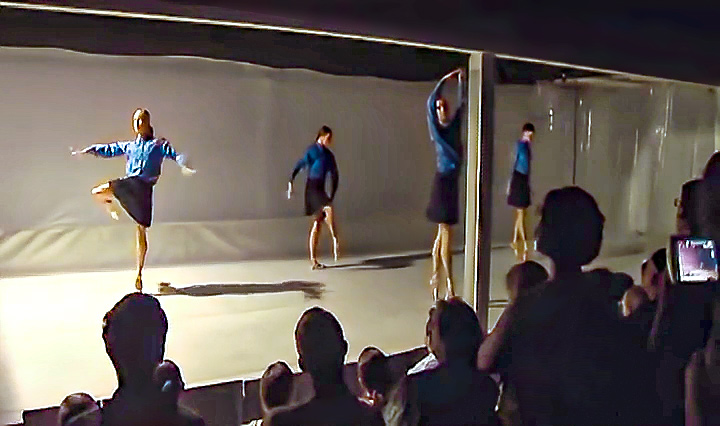
ballet bagatelle
2006
Reviews
Voyeurism 3 - Hillar's Ballet
bagatelle n 1 something unimportant or of little value
2 a bar game resembling billiards
Hillar Liitoja (long time director of Toronto's DNA Theatre) has choreographed a new ballet, his second. I of the Beholder - ballet bagatelle ran for four nights in July and is unlikely to be re-mounted anytime soon. Nonetheless, Liitoja's work is always well worthy of some after-the-fact analysis and discussion.
Liitoja staged the ballet in a new space on Niagara Street south of Queen. The Majlis is actually someone's home in the process of becoming an occasional coffee lounge/exhibition space. The cast used the main floor as a dressing area and the performance took place on a stage built out back in a converted garage. The audience watched from the backyard, protected from the elements by plastic sheeting and from the backalley action by a big wooden gate. Torches lined the way in to a scattering of chairs and a low stage with Marley floor and wings of sheer plastic. The setup invites a kind of intense voyeuristic experience - proximity is inescapable. You are so close to the dance - every little sweat mark and straining calf muscle is clearly visible. The cast too must be thoroughly aware of the audience pressed right up to the lip of the stage. There is little relief for them from the relentless gaze of the audience (clearly one of Liitoja's points). Understandably, each projects a sensibility that persists over the course of the evening - Magdalena Vasko has a bold, haughty almost hostile stare; petite Agata Mirosz is all ferocious concentration (perhaps because her chapbook of repeating jetes and sissonnes is the most technically challenging); Leslie Schroeter looks directly into the audience in a manner neither cold nor friendly, and the very young and lanky Catherine Maitland is simply not present - she is the Wili of the bunch, ethereal, introspective. Sheila Heti - a writer/performer trained in DNA but not ballet who dances what amounts to a cameo - well, I'll get to her in a minute.
The dancers begin their work with mathematical precision - each traverses the stage using a classical vocabulary that re-works the conventions of the enchainement (any connected series of steps). Some of the positions and shapes resemble those you might see in any ballet in the classical repertoire. Others simply defy the lexicon. Dancers fall off their pointes or slap their shoes noisily in a grotesque parody of classical ballet's effervescence as the dance degrades from intense order to controlled chaos.
Most of Liitoja's work addresses issues of control - he frequently manipulates the audience with commands and exhortations and often his staging includes devices of prompt for the performers. Here, the device consists of red and blue lightbulbs placed over the wings - each dancer has her own 'laneway' and a set of lightbulbs. There is clearly a complicated mathematical/architectural framework in place here, a kind of Sudoku of cues and stage commands. The dancers watch the lightbulbs intently and thus so do we. And at several points in the piece some of the dancers appear to trade lanes and vocabularies. It's not random but neither is the formula visible. Liitoja does not feel compelled to share his intent with the audience. But rewards do come to those who pay attention. I probably deserve half a gold star. It was clear to me that the flashing on of the bulbs heralded cues - one of the dancers later told me that blue means prepare to enter two seconds before the start of the music and enter on the music; red means a entrance in silence. That's a scratch at the service of meaning - Liitoja's algebra likely has much more to it than this. But for me even this most obvious device underscored the performers' purposeful dislocation from the music - Beethoven's Bagatelle # 4 in A Minor as interpreted by Glenn Gould and further manipulated by Liitoja, Vasko and sound designer Richard Windeyer. The score is as interesting as the choreography in many ways and yet they are not really connected; rather they are continually being held at arm's length by Liitoja. The score and the dance progress along different yet parallel paths, never quite touching. In a way, this makes the ballet a more intensely musical experience. Liitoja forces you to look and listen at the same time, which is quite challenging in the absence of harmony. You can't look away from the movement cause it's literally in your face; but the score (even when it devolves completely into an industrial drone that suggests an approaching train or airplane) is also omnipresent.
Though the movement never mimics the sometimes goofy transitions in the Gould, the score does trigger pronounced changes of mood in several sections. At one point Gould's interpretation has an almost rag-time sprightliness that the dancers address by beginning to relate to each other on stage - they begin to meet each others' eyes, smile slightly, grudgingly acknowledge each other and Heti, who dances a bizarre intervention within the ballet.
Up to the point of Heti's entrance it's all been very astringent and ruthless and that's what I like about contemporary ballet using classical technique - its capacity for being absolutely severe in the hands of the right choreographer. But these (to me) delicious qualities were mitigated somewhat by Heti's half-time appearances as the adorable sunny duckling among all those chilly swans. It's not that her dance isn't poignant - it is - or that she can't move - she can - but perhaps her position here has not been fully realized. She seems to represent something or someone that is deeply populist in the face of an event that is deeply elitist. She simply cannot do what the other dancers are doing though clearly she longs to. They tolerate her sweet spinning and gentle musicality for a time and then abruptly shove her back into the wings. Politically, I can totally see the point (applying a political framework being my idea, not Liitoja's); aesthetically, it's slightly unsatisfying.
But this is a quibble, a bit of a bagatelle of a qualifier to a work that is rigorous, disciplined and surprisingly refreshing for something so harsh. Liitoja is a fascinating artist and there are always riches to be had at a DNA presentation. ballet bagatelle shows his growing mastery of an idiom that is equally able to spawn cheese, gibberish or, here, a geometry that goes beyond basic mathematics.
Posted July 25, 2006
Guestbooks
After every performance, the audience exits into a space where Guestbooks are laid out. Some write in them; some don't. Some send emails which are then taped into the books.
- Brutally beautiful - love the cast
- (Kathleen Smith) - I beheld a dialogue between a sincere admiration and critique of the confines of classical ballet. I enjoyed the hypnotic and humour of it. The dancing was beautiful.
- (Henry Sansom) - Hillar - Here is the thing about all of your work. Its like sitting at one of the finest restaurants and being blindfolded. There is always an anticipation, an openness, a willingness for surprise. Willingness, anticipation of the unknown. The rigorous discipline, the commitment, the definition of movement and the pnes that those girls committed themselves to. It was lush and encoded.
- (Cheryl Daniels) - I loved your show last night. It was truly a wonderful experience. Totally engaging and smart and beautiful and harsh, in the best way - so dark and original and witty. You are doing dance but you are commenting on dance. You really are avant-garde in the true and best sense of the word. Questioning the form as you work within it, you are thus also outside it.
- (Sky Gilbert) - What you made those girls do on stage was filthy... and beautiful. Every time that brunette was at the front of the stage, slowly lunging down, then slowly rising up, I couldn't help but blush. I spent the afternoon watching World Cup soccer, and the evening's performance led me to a meditation on the fierce beauty of the ideal human form - the soccer boys and your ballet girls odd, but apt, counterparts. Both graceful and ruthless. Thank you for once again wrenching me out of my mundane routine and surroundings, and depciously confusing my senses.
- (Clarissa DeYoung) - It was such a treat to see something that was so acutely beautiful in so many ways.
- (Lauren)